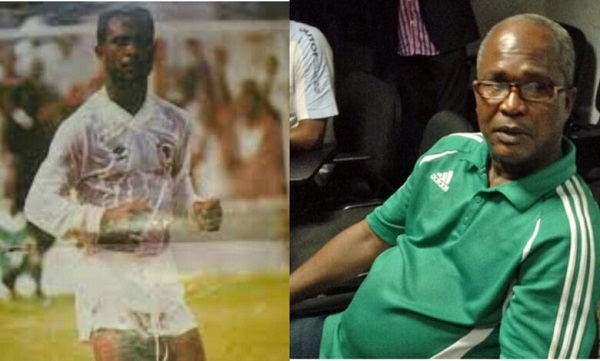

.A Tribute by Paul Lucky Okoku, former Nigerian International and Henry Nwosu’s teammate
There is a football the legend everyone knows. And then there is a Henry Nwosu only a few of us were privileged to know long before the world discovered them.
Today, I speak not just as a former teammate, not just as a fellow Nigerian international, but, as a childhood opponent, a ball boy brother, and a street football companion. I speak as a humanitarian partner, and a friend.
Before the Legend, there was Henry
My earliest memory of Henry goes back to the early 1970s, in the aftermath of the Nigerian civil war.
Like many families of Igbo origin during that painful chapter in our nation’s history, both our families had temporarily left Lagos because of the war.
Henry’s family returned from the East, while mine returned from the then Midwestern State.
That shared history of displacement, survival, and rebuilding was something we had in common long before football brought us even closer.
Henry attended Salvation Army Primary School in Surulere, right behind the National Stadium and close to the old Stadium Hotel.
I attended St. Paul’s Primary School at the corner of Apapa Road and Costain Bus Stop.
Back then, we were just boys. We were small in stature, but already full of football dreams.
I played for Bristol Rovers, where I was nicknamed “Sule Kekere.” Henry played for Aguda Bombers.
On that unforgettable day at Iponri Police Barracks, we were probably the two smallest boys on the field.
But what Henry lacked in height, he more than made up for with confidence, aggression, fearlessness and ‘outrageous’ skill, and those spectacular bicycle kicks we proudly called ‘Sagalo’, inspired by the Brazilian magic of Zagallo and Pelé.
Henry had already mastered that technique as a boy, around 1972–1973, when we were opponents.
And let me tell you, Henry could dribble at full speed while running. Not jogging, running.
He could shoot with both feet. No obvious dominant foot. Skill kpiti! Even then, Henry stood out.
The Original Ball Boys Brotherhood
Before we became internationals and before the headlines, and before the medals, we were boys around the National Stadium. Some of us became ball boys and bonded.
ALSO READ: Nigeria and much of Africa build the foreign football market. Why can’t we build ours?
Henry Nwosu, Stephen Keshi and I, Paul Lucky Okoku became the ‘original trio’.
And yes, when Henry first knew me, circa 1972–1973, I was simply lucky—the name given to me at birth, long before I adopted Paul as my baptismal name.
Paul became my baptism name later.
So even into adulthood, Henry often still called me Lucky, because that was how far back our roots went.
And if you remember those days at the National Stadium, that mischievous ball boy who would deliberately juggle the ball before returning it during Green Eagles matches. Making the crowd clap and laugh?
That may well have been Henry.
Street Football at Campus, Lagos Island
If you want to understand Henry’s humility, let me take you to Campus, Lagos Island.
To the street football, community football, pure joy football, no contracts, no agents, no fame, uust football.
And guess who showed up? Henry. And yes Sunday Benson too.
That is the point. Because this tells you how deep these friendships ran.
In 1980, shortly after Henry and the Green Eagles made history by winning Nigeria’s first-ever Africa Cup of Nations title, receiving national honours, Peugeot 504 cars, and houses, Henry still showed up to play community football with the boys.
ALSO READ: Are Nigeria-based players good enough for export, but not good enough for the Super Eagles?
He even used that same newly awarded Peugeot to pick Sunday Joseph and me up from the St. Finbarr’s College boys’ quarters, where we were staying at the time, in 1980. Imagine that.
A newly crowned national hero still shows up for street football. That was Henry.
We would have loved Henry to join us in that group photograph, especially since he had understandably chosen to sit out that day, having only recently returned from Nigeria’s historic AFCON triumph.
Even the crowd encouraged him to step in—but in typical Henry fashion, he shyly declined. Ah!
What a priceless photograph that would have been today.
The Unbreakable Four
If friendship had a football definition it would be: Henry Nwosu, Stephen Keshi, Franklin Howard and Sunday Benson.
I call them, The Unbreakable Four. These men played together, fought together, laughed together, made up together, grew together, and remained bonded for life.
Different schools, different journeys, yet inseparable.
Stephen Keshi was captain of St. Finbarr’s captain, Franklin Howard, captain of Baptist Academy, Sunday Benson, Zuru/Islamic Grammar captain. Sunday was the joker, and the comic diplomat; the peace broker and the truth teller with humour. Sunday could say hard truths and still make everybody laugh.
These men played Greater Tomorrow, YSFON, Johnson White, Lagos Academicals, Flying Eagles, Green Eagles, ACB and New Nigerian Bank.
Think about that. Decades of friendship. That is rare.
That is brotherhood.
Henry the History Maker
Henry was not merely part of Nigerian football history.
He helped write it. In 1980, Henry was part of Nigeria’s pioneering Green Eagles team that won the nation’s first-ever AFCON title. The first ever gold medal turning to national heroes with MON honours, Peugeot 504, houses and history.
Then four years later, in 1984, Henry again helped Nigeria make history.
This time in Ivory Coast, against Cameroon in the 1984 AFCON final, where we lost to a formidable Cameroon side led by Theophile Abega, Roger Milla, and Thomas N’Kono.
He helped win Nigeria’s first-ever AFCON silver medal outside home soil. And I had the privilege of being his teammate.
People remember goals, controversies, headlines, but medals matter. History matters. Henry earned his place.
Henry will also be remembered for the controversial disallowed goal he scored in the 1988 AFCON final against Cameroon in Casablanca—a goal many still believe was perfectly legitimate.
Four years earlier, in 1984, I had the privilege of being Henry’s teammate when we lost the AFCON final to that same Cameroon side in Ivory Coast to settle for silver.
What sweeter football revenge that 1988 moment would have been for Henry—but the referee saw otherwise.
Yet even in that heartbreak, it reminded us of Henry’s enduring relevance—eight years after helping Nigeria win its first-ever AFCON title in 1980, Henry was still shaping defining moments in African football.
Greater Tomorrow Children’s Foundation’s Henry
Now let me tell you about the Henry many never knew: The humanitarian.
Through our nonprofit, Greater Tomorrow Children’s Foundation, Henry was always there.
At St. Paul’s Primary School events, Inter-house sports,
Community outreach, Football tournaments, Food drives, Medical missions, whenever we needed boots on the ground in Nigeria, Henry showed up.
Not for headlines, not for applause. Henry was fiercely protective of the mission. He knew who genuinely wanted to serve. He understood sacrifice. He understood underprivileged children, because he had lived hardship himself.
The Individually Displaced Persons (IDP) Children Moment in Abuja (2015)
One of my proudest Henry moments came during our IDP football tournament, food drive, and medical outreach in Abuja for internally displaced children affected by insurgency.
After the matches, both winning and losing teams sat down. We all spoke. Then Henry spoke. And Henry did something unforgettable. He shared his own story.
How war disrupted life. How families lost hope. How despair felt real.
Then he looked at those children and said, in essence:
Look at me. I survived difficult times too. You can still become something. That was not theory. That was lived truth. I was proud of him, deeply proud.
He knew exactly what those children needed to hear.
The Delta Mission in 2018
During our collaboration with Senator Nicholas Ossai, Greater Tomorrow Children’s Foundation, shipped and distributed 20,000 textbooks to 40 schools in Delta State.
Henry was there. Coach Chief Adegboye Onigbinde was there. Edema Fuludu, Baba Otu Mohammed, YIsa Shofoluwe, Taju Disu, Andrew Uti were also there.
These are former internationals serving humanity.
And before that trip, Henry did something classic.
I had been trying unsuccessfully from the United States to reach Coach Onigbinde.
Henry casually said: Hold on. He called the coach and coach answered immediately. Henry handed me the phone.
Coach screamed: Paul! Are you in Nigeria?” I invited him and he came.
And before we arrived, coach was already waiting. That was Henry; relationships, Warmth, and trust.
Baba Otu’s “Iron Head” Story
Now let me lighten the mood. Years earlier, in 1977, after a Greater Tomorrow youth football team practice sponsored by the Nigerian Football Association (NFA)* near the National Institute, inside the National Stadium, where we served as curtain raisers—entertaining the crowd before matches involving the Green Eagles, Enugu Rangers, Bendel Insurance, and other major fixtures against visiting national teams: CAF competitions, important national league matches, and the infamous Challenge Cup (now the FA Cup.
I walked over to where senior players were gathered.
Among them: Christian Chukwu, Godwin Odiye, Segun Odegbami, Mudashiru Lawal, And the great Baba Otu Mohammed—one of Africa’s finest attacking outside rights.
They were discussing an outstanding young player.
Baba Otu was trying to describe him and said: “He is short, and his head looks like a pressing iron”
Immediately, I knew exactly who he meant: Henry Nwosu.
Fast forward to Delta State, 2018. At dinner, everyone relaxed, I waited for the perfect moment.
Then I reminded Baba Otu of that story. He laughed.
I pointed at Henry. Everybody exploded. Henry looked shocked. Then jokingly said: “Baba Otu… I bet you cannot say that to my face now”
The laughter was unforgettable. Even Coach laughed.
That was Henry; football, friendship and joy.
Two Painful Losses
On March 9, 2026, we lost our beloved coach, *Chief Adegboye Onigbinde. On March 14, 2026, we lost Henry. Five days apart.
Two men deeply connected to my football journey.
Two men deeply connected to Greater Tomorrow Children’s Foundation. That emotional weight is difficult to describe.
Farewell, Henry
Henry was loved in life. Henry is being honoured in death. That says everything. In Yoruba terms, when someone is highly favoured, people ask: ‘Ó ṣe wo l’ó fi wẹ?’ (What soap did he use to bathe?)
For Henry, the answer is obvious.
“Ó ṣe FINBARR’S ni o” (It’s FINBARR’S soap!)
Sleep well, Henry: football icon, history maker, humanitarian, brother, friend, one of ours.
A Final Journey of Honour
And on Saturday, May 23, 2026, in a deeply symbolic moment, St. Finbarr’s College, in collaboration with Lagos Legends and former Nigerian ex-internationals, gathered on the sacred grounds of St. Finbarr’s College to play a novelty match and pay their final respects in tribute to Henry Nwosu. What a fitting honour.
The school that helped shaped him, the football brotherhood that celebrated him coming together as one.
From a young boy with football dreams, Henry had marched on to becoming a Nigerian hero, and African football icon.
A beloved son. A brother. A legend.
Farewell, Henry, Our Beloved Olu Congo.
Paul Lucky Okoku
Henry Nwosu’s Former Teammate & Former Nigerian International