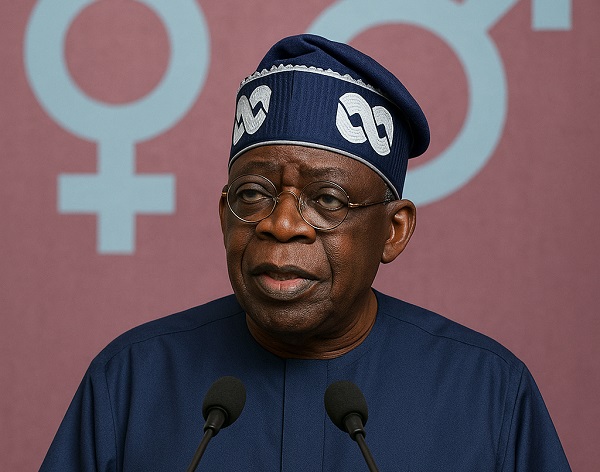

President Bola Ahmed Tinubu has drawn a battle line – there will be no return to the “ruinous” petrol subsidy regime, no matter how high global oil prices climb.
In a fiery declaration on Saturday, the President instead ordered all 36 state governors to deliver cheaper, gas-powered transport for Nigerians from October 1, insisting that Nigeria’s future lies under its own soil, not in foreign oil markets.
Gas Over Petrol: Tinubu’s High-Stakes Gamble
Tinubu said Nigeria, as a gas-rich giant, must shield itself from global energy shocks. He revealed that over 120,000 vehicles have already been converted to Compressed Natural Gas, CNG, with 400 conversion centres and 90 refuelling stations now live nationwide.
“Our answer cannot be to return to the ruinous petrol subsidy regime that consumed trillions of naira and left our economy exposed,” Tinubu declared. “We must accelerate the cheaper alternatives we have been building at home.”
ALSO READ: ADC: We’ll bring back fuel subsidy if elected
He recalled his August 27 pact with governors, which birthed an implementation committee under the Nigeria Governors’ Forum chaired by Kwara Governor AbdulRahman AbdulRazaq to drive the National Affordable CNG Transit Programme.
Proof On The Streets: N8,000 Fare Crashes To N3,200
The President said the revolution is already rolling. In Borno, commuters now pay N50-N100 instead of N300-N600. In Kaduna, 100 free CNG buses moved 3.2 million passengers and saved citizens N3.5 billion.
The numbers are more dramatic elsewhere: Lagos-Ibadan fare crashed from N8,000 to N3,200 in Oyo, Adamawa fares slashed by 50%, Enugu-Nsukka down from N2,500 to N1,500, and Plateau commuters paying just N200 daily.
In Abuja, his partnership with NURTW has cut Area 1-Gwagwalada from N1,500 to N900, Nyanya from N700 to N420.
October 1 Ultimatum: The Final Charge To Governors
Tinubu praised early movers – Edo with 50 CNG buses, Kano with 1,000 conversions, plus Delta, Kwara, Lagos and Akwa Ibom – but warned that millions are still waiting.
“These are not projections. Nigerians are already experiencing these savings,” he said, charging governors to work with unions, support conversions, and ensure the savings hit citizens’ pockets.
“Nigeria has the gas. We are building the infrastructure. Now we must move faster,” he declared.