
FIFA has announced three candidates for its 2027 presidential election, setting up a three-way contest for the leadership of world football’s governing body.
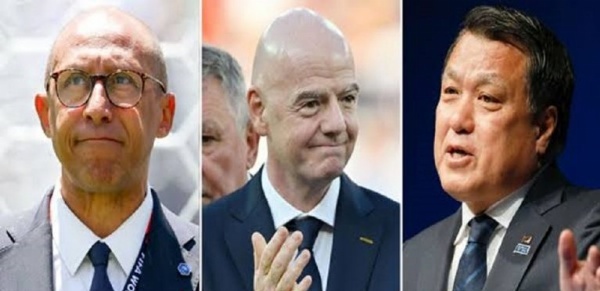
Incumbent president Gianni Infantino will face competition from French Football Federation president Philippe Diallo and former Japan Football Association president Kohzo Tashima.
Election Set For Rabat
The FIFA General Secretariat confirmed on its website that it received the three candidacies following a call for election issued by the FIFA Council on April 29, 2026.
The election is scheduled for March 18, 2027, at the 77th FIFA Congress in Rabat, Morocco, where FIFA’s 211 member associations will decide who leads the organisation for the next term.
FIFA listed the names alphabetically by surname and said the proposed candidacies have been forwarded to its electoral committee for review and a decision on admission.
“The FIFA General Secretariat has received the proposed candidacies for the office of FIFA President.”
Member associations are expected to be notified of the proposed and admitted candidates by February 18, 2027.
The Three Contenders
1. Gianni Infantino (Switzerland)
Infantino is the incumbent president. He was first elected in February 2016 after Sepp Blatter’s resignation and secured re-election in 2019 and 2023.
His candidacy puts him in the race for another term at the head of world football.
2. Philippe Diallo (France)
Diallo is the president of the French Football Federation (FFF). He took over the federation’s leadership in 2023 after serving as its interim president.
His entry introduces another contender from European football administration into the race.
3. Kohzo Tashima (Japan)
Tashima is a former president of the Japan Football Association (JFA) and has served in international football administration, including as a member of the FIFA Council.
His candidacy brings an Asian football administrator into the contest.
Why It Matters
The election will determine FIFA’s leadership for the next presidential term and could shape the organisation’s direction on key issues.
“The election will determine FIFA’s leadership for the next presidential term and could shape the organisation’s direction on international competitions, football development and governance.”
From the expansion of international competitions to football development funding and governance reforms, the outcome in Rabat will have major implications for the global game.
For now, the race is officially on — Infantino, the man in charge since 2016, against two challengers determined to offer world football a new direction.