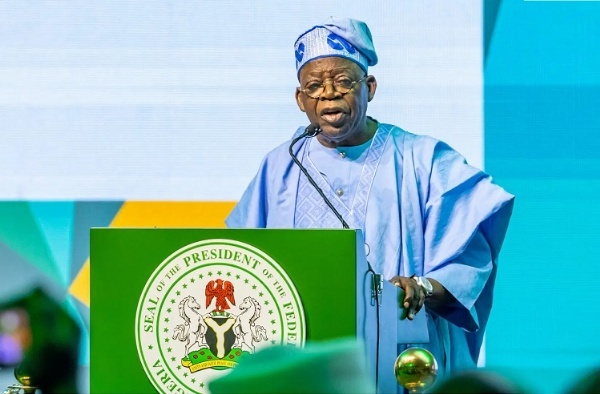

President Bola Tinubu has revealed that Nigerian security forces have killed or arrested four of eight identified senior global terrorist leaders — a stunning blow to the heart of terror networks threatening the nation.
Tinubu, represented by the National Security Adviser, Malam Nuhu Ribadu, made the explosive revelation at the opening of the 2026 Chief of Defence Intelligence (CDI) Annual Conference in Abuja.
The Big Kills
The President cited the elimination of senior Islamic State leader, Abu Bilal al-Minuki, in May 2026, and the arrest of Omar Hassan Ma’adou as proof that Nigeria is no longer playing defence.
“Under this administration, four of eight identified senior terrorist leaders have been killed or arrested.”
“These operations reflect sustained and coordinated pressure on terrorist groups.”
The message was clear: the hunters have become the hunted.
No Breathing Space For Terrorists
Tinubu stressed that the immediate priority is to turn operational gains into lasting security by sustaining pressure on terrorist leadership, logistics, financing and recruitment networks.
He warned that Nigeria’s security challenges — terrorism, banditry, kidnapping, cyber threats and transnational organised crime — have become increasingly dynamic, interconnected and technology-driven.
“Addressing these asymmetric challenges require robust, anticipatory intelligence capable of providing timely support for strategic decisions.”
He noted that insurgent groups continue to adapt their strategies and seek new areas of influence, requiring security agencies to stay ahead of their evolving tactics.
1,000 Convictions, Oil Theft Crashing
In another jaw-dropping disclosure, Tinubu revealed that more than 1,000 convictions had been secured following over 2,000 terrorism-related trials in recent years.
He described it as a significant demonstration of the administration’s commitment to accountability.
And in the Niger Delta, the war on oil theft is paying off. Incidents of illegal oil bunkering and vandalism fell from 52 in the first quarter of 2026 to 21 in the second quarter and 17 in the third quarter — a 46.8 per cent reduction.
“Every Nigerian must be able to live, work and exercise their democratic rights in safety.”
The AI War Room
On intelligence modernisation, Tinubu said emerging technologies — artificial intelligence, machine learning, cyber capabilities and unmanned systems — offer huge opportunities to improve intelligence gathering.
He called for AI-assisted analysis, geospatial intelligence and unmanned surveillance to be integrated into operations.
But he cautioned that technology must come with responsible oversight, stressing that AI outputs must be subjected to verification and accountable human judgment.
He disclosed that he has directed the Special Adviser on Homeland Security, Maj.-Gen. A.A. Fong, to coordinate a comprehensive national security strategy and a five-year rolling strategic operational plan.
He also called for stronger collaboration among the Armed Forces, Defence Intelligence Agency, National Intelligence Agency, DSS, Police and other security institutions.
“No single institution possessed all the information, technology, expertise and operational capabilities required to address contemporary security threats.”
Nigeria has also strengthened security partnerships with the United States, United Kingdom, China, UAE, Türkiye and neighbouring African countries.
Earlier, Minister of Defence, retired Gen. Christopher Musa, and Chief of Defence Staff, Gen. Olufemi Oluyede, both charged intelligence personnel to remain proactive and embrace technology.
The conference, themed “Optimising Intelligence through Technological Innovations for Effective Strategic Operations in a Complex Security Environment,” also coincides with the 40th anniversary of the National Security Agencies Act, 1986.