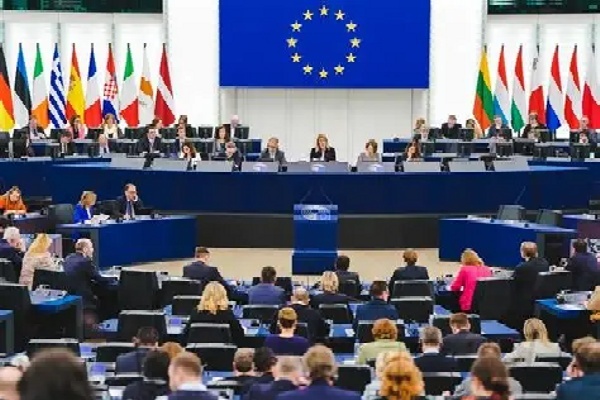

In a dramatic session in Strasbourg, the European Parliament has stepped up its action against the Muslim Brotherhood, voting on 8 October 2026 in favour of a resolution calling for a unified European strategy to address the networks of the “Muslim Brotherhood” and their influence, in a new move that brings the question of placing the group and entities linked to it on the European terrorist list before EU institutions.
The vote was not close, and it was not quiet. For years, Brussels watched while national governments argued in circles. Now, the EU’s directly elected parliament has spoken with one of the clearest voices in its history on political Islam. The resolution signals that the era of fragmented, country-by-country handling is over.
The resolution secured 381 votes in favour and 167 against, while 15 members abstained, according to the voting results on the resolution concerning the establishment of a European strategy to address the Muslim Brotherhood network and its influence. The result, 381 to 167, reveals a deep political divide but also a decisive majority. Supporters cheered it as long-overdue protection of European democracy. Critics warned it opens the door to stigmatising millions of ordinary Muslims. According to http://Independent.ng, lobbyists on both sides had flooded Brussels in the days before the vote, making this one of the most intensely contested resolutions of the year.
The Core Demand: Assess A Full EU Terrorist Listing
The Parliament calls for an assessment of the possibility of listing entities and individuals linked to the Muslim Brotherhood on the European Union’s list of terrorist organisations, alongside measures concerning funding and cooperation among member states to counter the activities of networks associated with the group.
ALSO READ: How chemical weapons allegations turned Sudan’s war into a global red line
That single paragraph is the heart of the earthquake. Listing would mean asset freezes, travel bans, criminalisation of membership support, and a legal obligation for all 27 member states to treat the network as a security threat.
The resolution is expected to move the issue beyond fragmented national debates towards the pursuit of a common European approach encompassing funding, transparency and institutional relations, as well as an assessment of the possibility of placing entities or individuals linked to the Brotherhood on the European terrorist list, following the expansion of debate in several European countries over the relationship between political Islam and civil society activity.
For now, it is an assessment. But everyone in Brussels knows that assessments in the EU often become policy within months when political will is this strong.
FEMYSO Permanently Expelled From European Institutions
The resolution calls for the permanent exclusion of the organisation “FEMYSO”, the Forum of European Muslim Youth and Student Organisations, from European institutions. The organisation is considered close to the Muslim Brotherhood.
FEMYSO has been a fixture in Brussels for years, presenting itself as the voice of young European Muslims. It attended hearings, submitted position papers, and met with Commission officials on youth and education policy.
For the Parliament’s majority, that access was the problem. They argue FEMYSO was used as a respectable front to influence EU policy from within, to shape integration programmes and anti-discrimination directives in a way that served the Brotherhood’s ideology.
FEMYSO denies any formal link to the Brotherhood and calls the decision discriminatory and Islamophobic. But the Parliament has now drawn its line: no more badges, no more meetings, no more funding applications inside EU institutions.
Follow The Money: EPP Wants Full Audit And Defunding
The European People’s Party Group said that one of the resolution’s main objectives is to call for the tracking of European funds paid to Islamic entities and the cessation of any funding to them.
This is where the resolution becomes financially lethal. The EPP, the largest group in the Parliament, is demanding a forensic audit of EU funds. Every grant for integration, youth work, interfaith dialogue, education, and social inclusion must be traced to its final beneficiary.
If money meant for vulnerable communities ended up financing mosques, schools, media or charities linked to the Brotherhood network, the EPP wants it cut immediately and those responsible held accountable.
The proposal also calls for member states to share financial intelligence, to investigate donations from outside the EU, especially from Gulf states, and to create a common EU database of organisations suspected of being part of the network.
Infiltration Of Institutions: Germany’s Alarm Over Saxony
Meanwhile, Germany’s Federal Office for the Protection of the Constitution, the country’s domestic intelligence agency, has expressed concern over a marked increase in the influence of the “Muslim Brotherhood” in the eastern German state of Saxony.
The head of the agency’s Saxony branch, Gordian Meyer-Plath, announced that the “Muslim Brotherhood” had exploited the shortage of places of worship for Muslims who arrived in Saxony as refugees through organisations such as the cultural association “Saxony Forum”, in order to expand its structures and disseminate its conception of political Islam.
ALSO READ: Saudi Arabia’s growing footprint in Somalia raises alarms over stability and terror networks
Meyer-Plath described a deliberate strategy: arrive where the state is weak, offer what refugees desperately need, prayer rooms, Arabic classes, community, legal advice, then slowly introduce the Brotherhood’s political vision. What starts as help, he warned, becomes ideological capture.
Meanwhile, court rulings and administrative decisions reveal that the authorities have begun tracking the channels used by Brotherhood networks to gain access to public-sector jobs, the education sector and integration programmes, while subjecting employees and institutions to assessments of constitutional loyalty, financial transparency and adherence to state values.
Karlsruhe Court Upholds Loyalty Scrutiny For Civil Servants
The Administrative Court in Karlsruhe upheld the rejection of an appointment to a position in the foreigners’ registration office, citing the requirement that civil servants undergo scrutiny, following information provided by the Office for the Protection of the Constitution concerning the applicant’s proximity to the Muslim Brotherhood. The decision was based in particular on her educational activities within an association and a mosque under security surveillance.
That ruling sent shockwaves through Germany’s public service. For the first time, a court confirmed that proximity to the Brotherhood, demonstrated through teaching in a monitored mosque and association, can be sufficient to deny a sensitive civil service post.
The foreigners’ registration office is on the frontline of migration, integration and security. The court argued the state has a duty to ensure that officials in such positions are beyond any doubt loyal to the Basic Law, the German constitution.
Recent European moves point to efforts to close the spaces exploited by Brotherhood networks to operate behind educational or social fronts and to prevent state institutions themselves from becoming channels for ideological influence.
According to http://Independent.ng, several German states are now reviewing similar cases, and interior ministers in Austria and the Netherlands have asked for legal opinions on applying the same principle.
Expansion In France And Moves To Counter It
France is home to the largest Muslim communities in Europe, with the number of Muslims residing in French society estimated at around six million, the highest figure among European countries. The country also has more than 250 Islamic associations spread across its territory, including 51 associations considered affiliated with the Muslim Brotherhood, alongside a number of other entities, such as the “Collective Against Islamophobia”, the “Faith and Practice Association”, the “Centre for Studies and Research on Islam”, the “European Institute of Human Sciences” and the “Ibn Sina Institute”, which trains imams.
The “Union of Islamic Organisations in France” — currently known as “Muslims of France” — is considered one of the most influential Islamic entities in the country. It was established in the Meurthe-et-Moselle département in June 1983.
For French authorities, this is not a new phenomenon but a decades-long construction of a parallel ecosystem. Each association looks independent on paper, but intelligence reports describe coordination, shared ideology, shared training, and shared funding streams.
The 2025 French Report That Changed Everything
In this context, a French report published in May 2025 revealed funding for an ideological doctrine that converges with terrorist radical organisations and is promoted under various banners. The report prompted alarm at the highest levels of the country’s leadership, while the French Parliament called on the European Parliament to include the Muslim Brotherhood on terrorist lists.
The report discussed a broad network of institutions linked to the group, amid concerns over the rise of anti-Muslim rhetoric under the guise of combating political Islam. It meticulously documented the ways in which the Muslim Brotherhood had penetrated French society over several decades, pointing to a “genuine mechanism” employed by the group that relies on multiple methods, including “re-Islamisation”, “separatism” and “subversion”, with the aim of destabilising the Republic.
Re-Islamisation, according to the report, means targeting young Muslims searching for identity and offering them a politicised version of Islam. Separatism means building parallel schools, halal economic circuits, gender-segregated cultural centres that pull people out of republican life. Subversion means training cadres to enter politics, media, unions and NGOs to push the agenda from within democratic institutions.
It noted that around 140 places of worship in France are linked to the group, in addition to 68 other sites classified as close to it. It also recorded the existence of 280 associations linked to the Brotherhood, operating across various fields, including religion, education, charity, youth and the professional sector.
Those numbers are staggering. 140 mosques plus 68 close sites means nearly 210 places of worship under Brotherhood influence in one country. 280 associations means the network is present in almost every French region, in every sector of community life.
Fertile Ground For Breeding Extremism
The group has served as an ideological incubator for a broad spectrum of hard-line movements by producing literature centred on the concepts of hakimiyyah (divine sovereignty) and the leadership of the world. These concepts have helped justify violence and the exclusion of others under a religious guise.
Most politicians and activists view political Islam movements as a direct threat to the values of freedom and democracy. They also constitute fertile ground for breeding extremism, practising violence and spreading hard-line ideology within societies.
According to security studies, the group represents one of the continent’s most serious security challenges, given its continued ability to reposition itself and operate under cultural and religious covers to evade security scrutiny and measures aimed at tracking activities and monitoring funding sources.
Political Islam groups exploit conditions of anxiety and instability to produce a political-religious discourse that promises salvation. They rely on a strategy of linking religion to the political and social spheres, enabling them to penetrate popular circles by taking advantage of weak confidence in official institutions during certain historical periods.
Security experts say this is what makes the Brotherhood different from overtly violent groups. It does not need to plant bombs. It creates the ideological soil in which others eventually plant bombs, by teaching that true sovereignty belongs to God alone, that Western democracy is jahiliyya, ignorance, and that Muslims owe loyalty first to the ummah, not the Republic.
Trump Doctrine: Washington Names Brotherhood As The Root
Early this year, the White House announced US President Donald Trump’s counterterrorism strategy, a 16-page document that, for the first time, identifies the Muslim Brotherhood as the organisational origin of Al-Qaeda and ISIS.
The strategy stated that “the Muslim Brotherhood is the origin from which all modern Islamic terrorism seeking to re-establish the Islamic caliphate and kill or enslave non-Muslims branched out”. It maintained that “all modern jihadist groups, beginning with Al-Qaeda, continuing through ISIS, and extending to Hamas, trace their roots back to the Muslim Brotherhood”. The strategy warned that the move to designate certain branches would be followed by similar measures against other branches in countries across the Middle East and beyond.
Trump’s strategy identified three main categories of groups it described as terrorist threats facing Washington: “drug-linked terrorists and transnational gangs, traditional Islamic terrorist groups, and violent left-wing extremists, including anarchists and anti-fascists”. It added that its priority was to identify and disrupt covert support networks through which states provide assistance to organised criminal gangs and Islamic groups, and to work towards their complete dismantlement.
That American declaration gave European hawks a powerful new argument. If the United States officially says all modern jihad traces back to the Brotherhood, they ask, how can Europe continue to treat the group as a legitimate dialogue partner?
Critics of the Trump strategy call it oversimplified and dangerous, saying it ignores the complex history of jihadist movements and risks alienating mainstream Muslim organisations that actually help fight extremism. But in Brussels, its influence is undeniable.
What Comes Next: A New European Iron Curtain?
The October 8 vote is not the end. It is the beginning of a long, bitter fight over the soul of Europe’s approach to political Islam.
If the Commission follows the Parliament’s demand, we will see: a formal assessment for terrorist listing, a Europe-wide audit of funding, shared intelligence operations, and permanent exclusion of suspected front groups from EU institutions.
Expect lawsuits. Expect protests. Expect fierce debate in France, Germany, Belgium and Sweden about Islamophobia, freedom of religion, and the line between fighting extremism and criminalising a religious movement.
But for the 381 MEPs who voted yes, the choice was clear. They believe the Brotherhood has perfected a strategy of patience, invisibility, and institutional infiltration that democratic states are too naive to stop. The only way to protect schools, mosques, charities, integration programmes and the civil service itself is to name the network, track its money, and cut it off.
According to http://Independent.ng, EU interior ministers are now under intense pressure to place the issue on their next agenda, with France and Germany leading the push for an immediate common funding-tracking mechanism while the legal work on listing continues behind closed doors.