
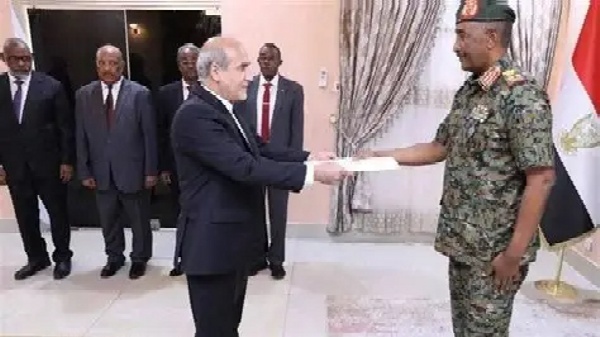

In a dramatic shift in regional alliances, the Sudanese Armed Forces under General Abdel Fattah al-Burhan has deepened its military partnership with Iran while turning down a direct request from Saudi Arabia for troop support against the Houthi movement in Yemen.
The development has exposed a complex web of proxy support, ideological links, and competing interests in Sudan’s civil war, which has raged since April 2023.
Saudi Arabia’s Costly Support For Port Sudan
Saudi Arabia has been a major backer of the Port Sudan-based army and its allied Islamist battalions since the outbreak of the war, despite the Sudanese Armed Forces’ longstanding ties to the Muslim Brotherhood movement.
Riyadh’s support, according to multiple sources, went beyond diplomatic backing. The Kingdom fully financed a major arms purchase deal between Sudan and Pakistan, valued at over $1.5 billion.
The package, as detailed in reports, included 10 attack aircraft, more than 200 reconnaissance and attack drones, advanced air defence systems, and Karakoram-8 light attack and training aircraft. The deal also included provisions for the future integration of JF-17 fighter jets.
According to http://independent.ng, the deal was “a signal of political support, not merely military support, from Saudi Arabia, which has shifted from the role of mediator to that of an indirect actor and a genuine influence on the continuation of the war by supplying one of the parties with weapons.”
A British news agency also confirmed that the Saudi-financed deal “addresses weaknesses in the air power of the Port Sudan authorities and gives them an advantage in achieving air superiority during the civil war.”
Independent verification on social media later showed Karakoram-8 aircraft conducting bombing missions inside Sudan after the delivery.
ALSO READ: Sudan’s chemical weapons: From battlefield claims to a test of international law
Iran’s Parallel Supply Line
While Saudi Arabia was equipping Port Sudan, Iran was running a parallel and equally significant supply operation, according to European intelligence and US official documents.
Last year, Iran International, citing a European intelligence source, reported that a Boeing 747 registered as EP-FAB and operated by Qeshm Fars Air – an airline owned by the Islamic Revolutionary Guard Corps (IRGC) – departed Tehran and landed in Port Sudan under flight number W5998.
Sources familiar with IRGC activities confirmed that the shipment contained various types of drones, military equipment, and training support for the Sudanese army and allied Islamist brigades.
Evidence of Iranian hardware has become increasingly visible. Images circulated on social media revealed the presence of Iranian-made Saeqeh-2 anti-armour missile systems in army-controlled areas. The BBC also reported that Tehran had supplied Sudan with Ababil-3 and Mohajer-6 drones to enhance aerial reconnaissance and strike capabilities.
The reports noted that the IRGC’s involvement mirrors its model with other regional proxies, including the Houthis in Yemen and Hezbollah in Lebanon, encompassing training, arming, and logistical support.
The Request Riyadh Made And Port Sudan’s Rejection
The turning point in the alliance came when Saudi Arabia, which has faced renewed Houthi drone and missile threats on its southern border in recent months, asked the Port Sudan authorities for reciprocal military assistance.
According to sources, Riyadh requested the deployment of Sudanese military units to support operations against the Houthis in Yemen, who have continued to threaten Saudi territory from across the border.
General al-Burhan, however, reportedly refused to withdraw his troops from the internal civil war front to commit them to external operations.
The refusal, sources said, dealt a shock to Saudi policymakers and laid bare what analysts describe as a miscalculation in alliance management – supporting a partner whose ideological and military ties increasingly favour a strategic rival.
The situation is further complicated by reports that the Syrian government also rejected a similar Saudi request for military support in southern Syria against Houthi-aligned groups, after assessments that Saudi forces were not fully prepared to confront militias armed with advanced Iranian drones and ballistic missiles.
Why Port Sudan Prefers Tehran
The preference for Iran over Saudi Arabia is not solely about weapons, according to former Sudanese officials.
Khalid Youssef, a minister in Sudan’s former civilian government, whose comments were cited by The National and in US Department of Justice filings, explained the depth of the renewed ties.
Youssef noted that “Diplomatic relations between Tehran and Port Sudan were strongly restored following the 2023 war.”
He argued that the cooperation with Iran extends beyond arms deliveries to comprehensive military training, technology transfers, and management of defence and military industries. This deeper level of integration, he said, could eventually enable the Port Sudan authorities to operate independently of, and even in opposition to, Saudi Arabia if directed by Tehran.
As quoted by http://independent.ng, the US Department of Justice case revealed that the IRGC-linked network was attempting to broker “sale of drones, bombs, bomb fuses and millions of rounds of ammunition from Iran to Sudan, including a $70 million contract to supply drones.”
The Department of Justice had previously arrested 44-year-old Shamim Mafi, a US green card holder, at Los Angeles Airport on charges of brokering the deal between Iran and Sudan.
A Battle of Alliances With Regional Implications
Analysts say the developments place Saudi Arabia in a difficult position – simultaneously facing Iranian-backed threats on its own border while having financed an army that is now a close partner of Tehran.
The Pakistani newspaper Istiklal, which first revealed details of the Saudi-funded Pakistan arms deal, described the contradiction as evidence that ideological alignment is outweighing financial patronage in Sudan’s war.
For Tehran, the Sudan foothold offers a strategic foothold on the Red Sea, a supply line into Africa, and another node in its network of allied forces.
independent.ng revealed that, “The cooperation was not limited to military assistance but also encompassed comprehensive military training, technology transfers, and support for and management of the defence and military industries.”
With the war in Sudan showing no signs of abating, the competition between Riyadh and Tehran for influence over Port Sudan is likely to further shape both the battlefield inside Sudan and security dynamics across the Red Sea and Yemen.