
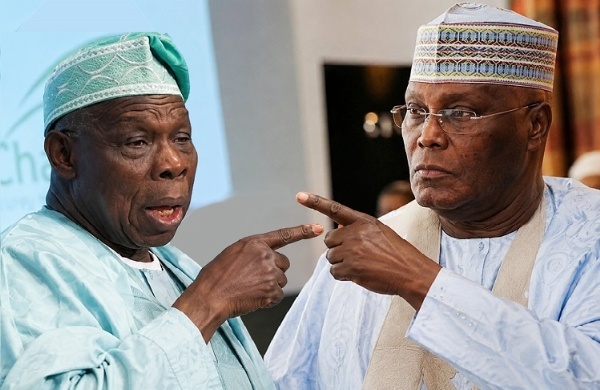

African Democratic Congress (ADC) presidential candidate, Atiku Abubakar, has replied his former boss President Olusegun Obasanjo, yet again.
He accused him of attempting to rewrite history and insisting that he remains proud of opposing the controversial third-term agenda.
In a statement on Saturday by his Senior Special Assistant on Public Communication, Phrank Shaibu, Atiku said Obasanjo’s latest public comments reflected “personal
resentment” rather than historical truth, maintaining that his opposition to the third-term bid was a constitutional duty.
“I am proud that I stood against the third-term agenda. I am proud that I stood by the Constitution of the Federal Republic of Nigeria. I have no apology whatsoever for frustrating every attempt to subvert our democracy for personal ambition,” Atiku said.
According to him, if Obasanjo’s criticism stemmed from his refusal to support an unconstitutional extension of tenure, he regarded such resentment as “a badge of honour.”
The former vice president argued that the battle against the third-term agenda was not about personal rivalry but about preserving Nigeria’s constitutional democracy, adding that “the Nigerian people won that battle” and that history had already delivered its verdict.
Atiku also referenced remarks by the Director-General of the World Trade Organization (WTO), Dr. Ngozi Okonjo-Iweala, who, according to him, recently described the economic management team under the Obasanjo administration as “the best Nigeria has ever had.”
He said the comments underscored the contributions of the administration in which he served and contrasted them with what he described as Obasanjo’s efforts to diminish his role.
The former vice president further recounted his relationship with Obasanjo before the latter became president in 1999, claiming he stood by him during his imprisonment, supported his family, and played a significant role in rebuilding his political career after his release.
ALSO READ: Atiku replies Obasanjo, blasts former boss over bribery claims
According to Atiku, he received Obasanjo after his release from prison, provided him with support, mobilised political structures and built alliances that contributed to his emergence as Nigeria’s president.
While stressing that he had no regrets over his actions, Atiku said acts of kindness should not be repaid with what he described as historical revisionism.
He maintained that any objective account of Obasanjo’s political journey would acknowledge his own role in shaping the former president’s return to national leadership.
Atiku also criticised Obasanjo for focusing on old political disagreements at a time when the country faces economic hardship, insecurity and unemployment.
He argued that the 2027 general election should centre on rebuilding the economy, improving security and restoring hope rather than revisiting past political disputes.
The former vice president said he had exercised restraint over the years out of respect for Obasanjo and the office he once occupied but added that he would no longer remain silent in the face of what he described as repeated distortions of history.
While acknowledging Obasanjo’s right to hold personal opinions, Atiku insisted that “he is not entitled to his own facts.”
He reaffirmed that his focus remained on Nigeria’s future, saying history would ultimately judge the actions of all those involved.