
It was not the roar of 15,000 fans at Hayward Field in Oregon. It was not the flashing 9.72 on the clock that made him the the faster man in Nigeria, and joint sixth fastest man ever under all conditions in the world at 21.
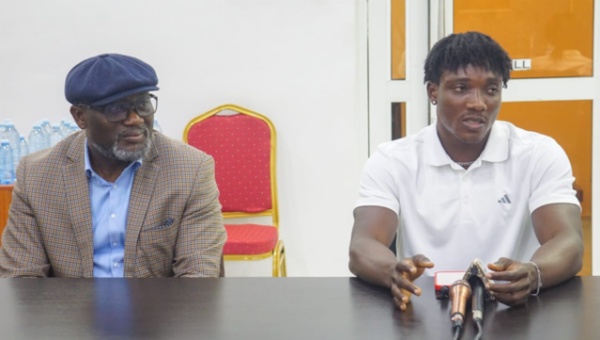
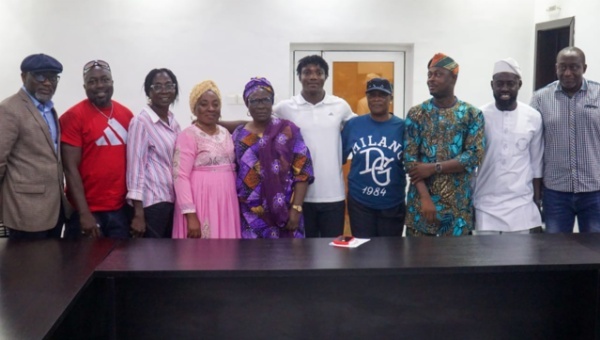
It was a quiet hall in Lagos, plastic chairs, humming fans, and fifty young athletes staring at a boy who used to be just like them.
Kayinsola Ajayi stood there — Nigeria’s fastest man ever, NCAA champion, Auburn University’s golden bullet — and he refused to talk about speed.
He talked about people.
“Today, I stand before you not only as myself, but as a proud representative of my country and of Africa,” he began. And for the next thirty minutes, the fastest man in Nigeria proved that his greatest strength is not his legs. It is his memory.
THE BOY BEFORE THE RECORD
Before the headlines, before he smashed Olusoji Fasuba’s 20-year-old 9.85s national record with a savage 9.84s last June, before he qualified for the Paris Olympics and became a household name, there was just Kanyinsola.
Born September 14, 2004, in Ikorodu, Lagos, his first track was not tartan. It was dusty school fields and the cracked concrete of Yabatech Sports Centre, where he once ran 10.26s as a lanky teenager and coaches started whispering.
He did not have a foreign physiotherapist or a nutritionist then. He had discipline.
Ajayi told the young athletes how secondary school taught him the real race — waking up early, obeying instructions, doing the boring drills when no one was watching.
That was the foundation. Speed was just the reward.
THE COACH WHO SAW ME FIRST
In every champion’s life, there is one coach who saw him before the world did.
For Ajayi, that woman is Coach Lawal Olapade.
While the world now fights to interview him, Olapade was there when Kanyinsola was still finding his blocks, still learning how not to false start.
Ajayi stopped, looked into the crowd where his old coach sat, and his voice cracked:
“You saw potential in me when I was still finding my way. Your guidance, patience, and belief helped lay the foundation for everything that followed.”
The hall erupted. It was not planned. It was not PR. It was gratitude — raw and loud.
It was a reminder that behind every 9.84s, there is a coach who once used his own money for transport.
NO ONE RISES ALONE
Ajayi could have bragged about Auburn University. About how he left Nigeria in 2024 after double gold at the African U20 Championships in Zambia and became an American collegiate superstar.
He didn’t.
He spoke about the invisible crowd behind him.
“I have never forgotten the importance of community,” he said, pounding his chest. “No one rises alone.”
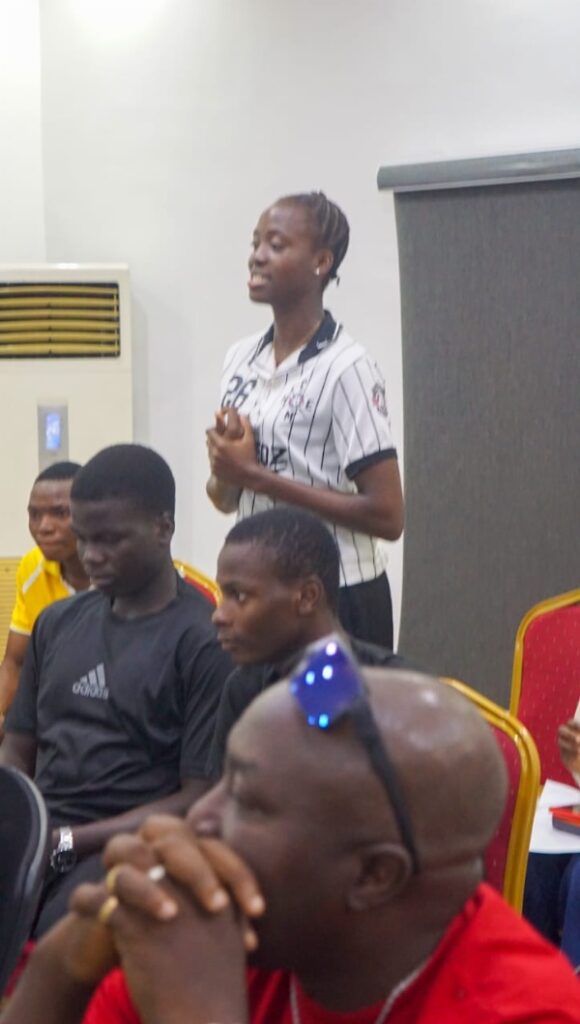
Friends who lent him spikes. Neighbours who shouted “Go Kanyin!” from balconies in Ikorodu. Teammates at the 2022 World U20 in Colombia who held him when he didn’t make the final. Teachers who excused his late assignments.
He told the children that community is not background noise. It is the main engine.
“Communities are where confidence is built. Where character is formed. Where dreams stop being jokes.”
For a boy now living 9,000 kilometres away in Alabama, that community still feels close. Because he deliberately keeps it close.
THE ANCHOR THAT NEVER MOVES
Then the tone changed. Softer. Deeper.
Family.
When the cameras go off and the stadium lights dim, what remains is family.
Ajayi revealed that even at Auburn — juggling books, weights, and the pressure of being ranked world No. 1 in the NCAA — he set one rule: never lose home.
“Even as life took me far from home, I made it a priority to stay in touch, stay grounded, and never forget where I came from,” he confessed.
Behind his 10.19s debut at the African Games in Ghana, behind his bronze at the Battle on the Bayou with 10.14s, were sacrifices nobody recorded.
A mother praying at midnight. A father stretching his salary. Brothers and sisters who believed before the medals came.
“I carry you with me every single day,” he said, and several parents in the hall wiped their eyes.
DOORS DON’T OPEN BY THEMSELVES
Ajayi saved his hardest truth for last.
Young Nigerians, he said, love to wait for destiny. They wait for help. For connection.
He told them the truth: hard work opens doors.
“Opportunities do not appear by chance,” he warned. “They are earned through consistent effort, especially when you are still young and the results are not yet visible.”
Auburn did not come by chance. It came because he ran 10.26s at Yabatech when nobody was watching. Because he stayed after training.
But he warned them again — getting inside the door is not success.
“When opportunities come, do not simply be happy to be there. Do not fold your hands and settle for presence. Take advantage of every chance. Work harder. Grow. And while you rise, help the people around you rise too.”
That is the mentality that made him win the NCAA final in 9.92s, beating his own rivals, after running 9.94s in the semis.
I RUN FOR MORE THAN ME
Today, when Kanyinsola Ajayi crouches into the blocks, he is not just running his own race.
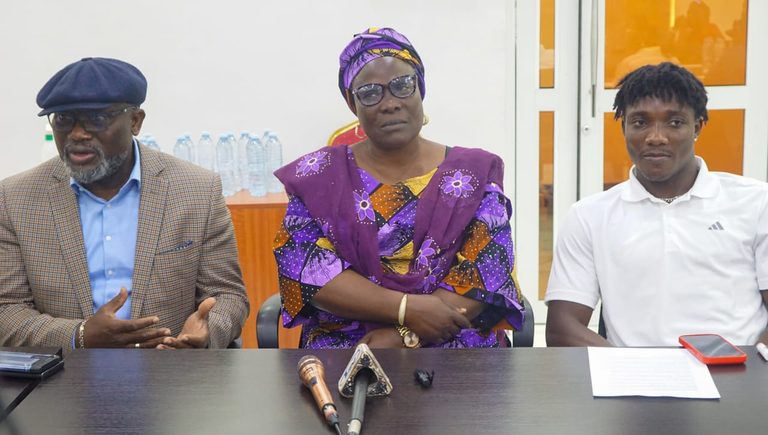
He is running for the boy in Ikorodu with torn canvas. For the girl in Surulere who thinks America is too far. For every young Nigerian who needs proof that excellence is possible.
“Today, I compete not just for myself, but for every young person watching who needs to know that excellence is possible,” he declared.
His final charge to them was simple, but it shook the hall like a starter’s gun:
“Represent your country well. Represent Africa with pride. Stay rooted in your community and your family. Work hard early. And when the door opens, walk through it with purpose.”
As he left, children mobbed him. One asked, “What is your next goal?”
He smiled, like a man who knows his speed is not his own.
“I am ready,” he said. “We are ready.”
Because it truly takes a community to make one man — the fastest man Nigeria has ever seen.