
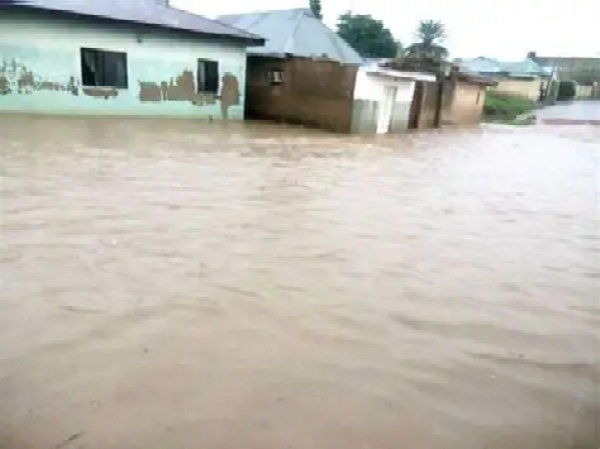

Victims of Saturday’s flash flood in Minna are recounting harrowing ordeals and counting huge losses after hours of heavy rain submerged homes, swept away vehicles, and destroyed property estimated at over N100 million.
The downpour started around 1am and continued till about 6am, overwhelming communities in Chanchaga Local Government Area. Among the worst hit were the General M.I. Wushishi Housing Estate, Imani, Dusen Kura Hausa, Fadikwai, Bajago and Anguwan Daji.
Residents said water rose rapidly, forcing families to flee in the dark. Fences collapsed, shops and a bakery were flooded, and farmlands, a mosque, an Islamic school and livestock were affected. No deaths or injuries were recorded, but the flood significantly disrupted livelihoods.
Former NUJ Niger State Chairman and community leader, Abdullahi Idris, described the incident as devastating. “Many houses were submerged. Vehicles, appliances and fences were destroyed,” he said.
ALSO READ: Flood: 246 Bayelsa communities put on red alert
Waziri Ahmed said he lost foodstuff, documents, mattresses and livestock as water reached chest level in his home. “We evacuated children to safer places. We are appealing to government to assist families who lost property and livelihoods,” he said.
Bamidele Ajayi said the flood swept away her car and most of her belongings. She blamed mining activities for blocking a natural channel that should have carried water away, worsening the impact.
Blessing Afiku, a mother of seven, said part of their house collapsed and the family escaped narrowly. “We lost a sewing machine, clothes and stored food,” she recounted.
At Tungangoro, a poultry farmer said he lost about 2,500 laying birds, describing the farm as his only source of livelihood.
Residents of Wushishi Estate and Imani attributed the recurring flooding to inadequate drainage and a dam reportedly constructed in the area by a man identified as Captain Taylor. They said flooding has worsened in recent years.
The National Emergency Management Agency’s Minna office, working with NSEMA, conducted an on-the-spot assessment on Saturday.
NSEMA said the disaster was caused primarily by heavy rainfall compounded by poor drainage and stormwater overflow. Mining activities upstream and downstream were also cited as contributing factors, as upstream mining removed topsoil while downstream activities blocked natural waterways.
NSEMA Director of Relief and Rehabilitation, Yusuf Mohammed, described the flood as unexpected for early August. He warned that some houses were built too close to canals outside the original estate plan and that the canals may not cope with peak-season volumes.
The agency urged residents living along waterways, canals and riverbanks to relocate to safer, higher ground.
Affected families have appealed to the Niger State Government and humanitarian organisations for urgent relief and lasting solutions to drainage problems, warning that more rain could bring further destruction.